Buying Your First Wheelchair Accessible Vehicle: A Plain-English Guide
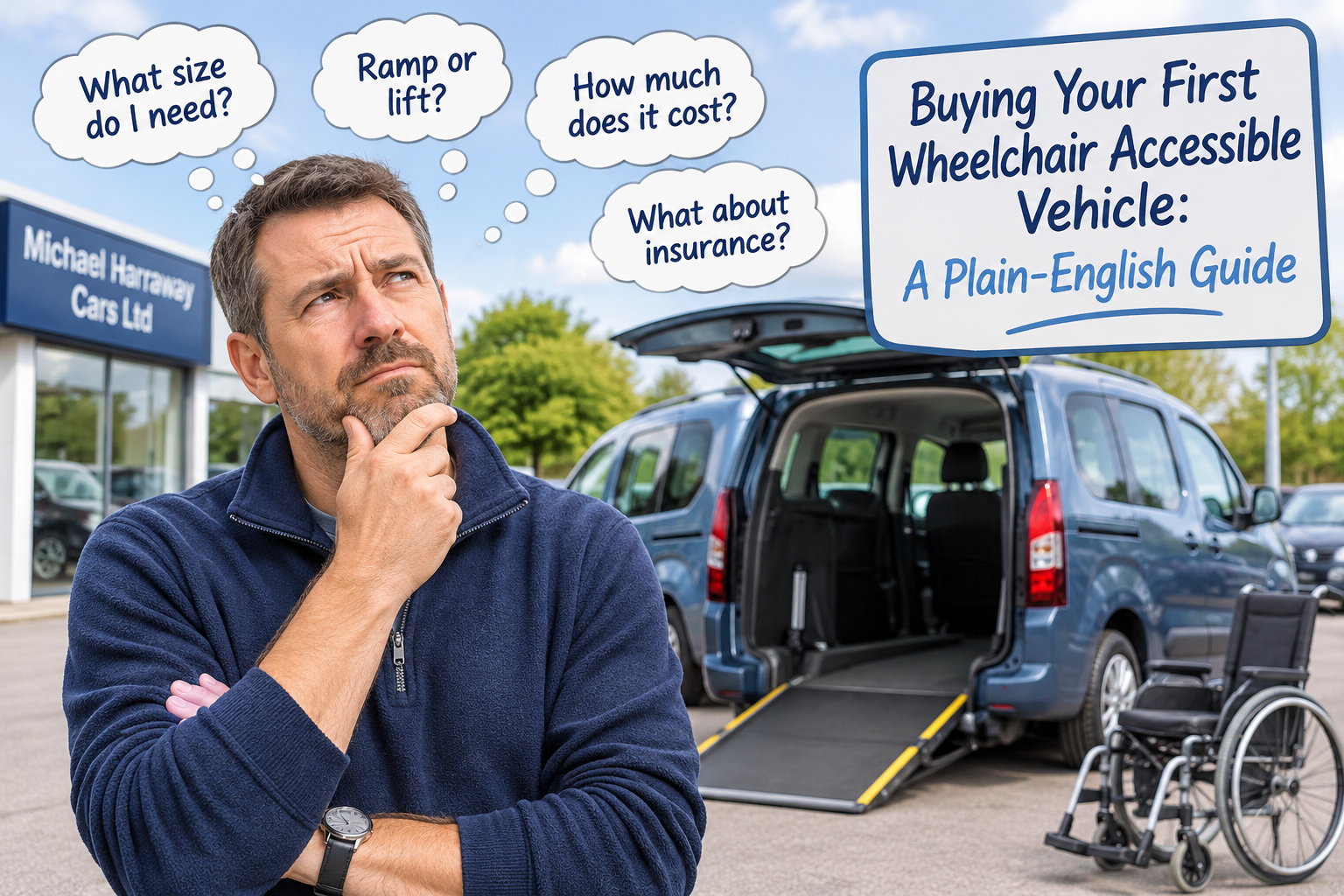
Most people who ring me about buying their first wheelchair accessible vehicle (WAV) start in the same place. Something has changed, sometimes quite suddenly, and they now need a car that a wheelchair or mobility scooter can travel in.
They’ve been looking at adverts online, but every vehicle seems to use terms and descriptions they’ve never needed to understand before.
That’s completely normal. Most people buying their first WAV have never owned one before, and nobody expects you to know the difference between a three-seat and a five-seat conversion, or whether a particular ramp will suit your wheelchair.
I’m Michael Harraway. I joined the motor trade in 1991, started Michael Harraway Cars in 2005 and have specialised in used wheelchair accessible vehicles for around 10 years. We’ve now sold more than 500 WAVs.
Over that time, I’ve spoken to lots of people in exactly this position. This guide covers some of the main decisions worth thinking about before you start looking at individual vehicles. Get a few of these things clear in your mind and the choice becomes much smaller and easier to manage.
When you’re ready to look at a particular vehicle, my separate guide to buying a used wheelchair accessible vehicle and what to check before you buy will help you with the next stage.
Will the wheelchair user be a passenger or the driver?
This is the first question to answer because it makes a big difference to the type of vehicle you need.
Most used WAVs are designed to carry someone who remains seated in their wheelchair while travelling. These are often called passenger WAVs. The wheelchair user travels in a designated space, usually accessed through a rear ramp, while someone else drives the vehicle.
This is the type of WAV we specialise in at Michael Harraway Cars. Every vehicle we sell is designed to carry a wheelchair user as a passenger.
There are also vehicles adapted so that someone can drive while remaining seated in their wheelchair. These are quite different conversions and require specialist adaptations and assessments.
We don’t sell drive-from-wheelchair vehicles. If that’s what you need, I’d recommend speaking to an independent Driving Mobility assessment centre. They can help establish what adaptations might be suitable and what type of vehicle to look for.
Where would the wheelchair user like to sit?
With a passenger WAV, the wheelchair position is one of the most important things to consider.
There are several different layouts, and it’s worth thinking about how you normally travel rather than simply choosing the vehicle with the most seats.
Behind the front seats
This is one of the most common arrangements. The wheelchair user travels in the rear of the vehicle, behind the driver and front passenger seats.
Depending on the conversion, there may also be room for additional passengers alongside or in front of the wheelchair position.
Behind a row of seats
Some five-seat WAV conversions have a wheelchair position further back, behind a row of conventional passenger seats. This can work well for families who regularly travel with several people, although the overall layout and available space need to be considered.
Beside the driver
Some WAVs allow the wheelchair user to travel in the front passenger position, next to the driver.
These conversions are less common on the used market, so there tends to be less choice available. We do get them into stock occasionally, although it’s worth knowing that they are generally more expensive than a rear wheelchair passenger WAV of a similar age.
For some people, having the wheelchair user sitting alongside the driver is a real advantage, particularly if they usually travel as a pair. It gives them the opportunity to sit together rather than having the wheelchair user travelling in the rear of the vehicle.
As with any WAV, it’s worth thinking about how you normally travel and which seating arrangement would work best for you.
Do you need to carry a wheelchair or a mobility scooter?
Not everyone looking for a WAV is buying one to carry a wheelchair passenger. Around half of our customers are looking for a practical way to transport a mobility scooter.
A WAV can make this much easier than trying to lift a scooter into the boot of an ordinary car. The rear ramp allows the scooter to be driven or wheeled into the vehicle, where it can be secured for the journey.
Most WAVs have one designated mobility space, which would normally be used for either a wheelchair or a scooter. Some of the larger vehicles may have enough room for additional equipment or passengers, but it’s important not to assume that both will fit.
If you’re buying to carry a scooter, check its actual dimensions and weight. A compact scooter may fit comfortably into a smaller WAV, while a larger 8mph or off-road model may need considerably more room.
The same applies to wheelchairs. The size of the wheelchair, its footrests and the height of the person sitting in it can all affect which vehicles are suitable.
If you use a manual wheelchair, an electric winch may help with loading, if the vehicle has one fitted. Most powered wheelchairs can simply be driven up the ramp and into the vehicle.
Don’t rely on a vehicle description alone. The best way to know whether something will fit is to try it in the actual vehicle.
Should you choose a small WAV, a medium-sized WAV or a larger one?
WAVs come in different shapes and sizes. Some are based on familiar family cars, while others offer more interior space and are based on larger MPVs or van-style vehicles.
Neither is automatically better. The right choice depends on the space you need, how many people normally travel with you and where you intend to use the vehicle.
Smaller WAVs
Examples: Peugeot Rifter, Citroën Berlingo, Ford Tourneo Connect and similar compact WAV conversions.
- Generally feel more like an ordinary family car to drive.
- Often easier to park and manoeuvre.
- Can accommodate many manual wheelchairs and compact mobility scooters, depending on their dimensions.
- Usually have less interior and wheelchair space than larger conversions.
Medium-sized WAVs
Examples: VW Caddy Maxi, Ford Grand Tourneo Connect, Peugeot Rifter long and Dacia Jogger.
- Offer a useful step up in space compared with smaller WAVs.
- Can provide more room for the wheelchair passenger and additional passengers.
- Some models, such as the Peugeot Rifter Plus, are available in layouts offering five conventional seats plus a wheelchair passenger, or fewer seats with a larger wheelchair area.
- Often provide a good balance between passenger space, wheelchair accessibility and overall vehicle size.
- Worth considering if you need more room than a compact WAV provides but don’t necessarily want a larger van-based vehicle.
Larger WAVs
Examples: Renault Trafic, Ford Tourneo Custom and Citroën SpaceTourer.
- Generally offer more interior space and a wider choice of seating arrangements.
- Can be particularly useful for taller wheelchair users, larger powered wheelchairs or families who regularly travel together.
- Their larger dimensions can take a little more getting used to, particularly when parking and manoeuvring.
- Vehicle height is important to consider if you regularly use multi-storey car parks.
There can also be differences within the same model range. Some vehicles are available in standard and long-wheelbase versions, with the longer versions offering additional interior space.
For example, a Peugeot Rifter Long provides noticeably more room than the standard Rifter. That extra length can make a real difference to the wheelchair area and the space available for passengers.
It’s worth remembering that these categories are a general guide. The actual space available depends on the vehicle and the conversion fitted to it.
A larger WAV isn’t necessarily the right answer. Think about how much room you actually need, where you’ll park it, the height restrictions you regularly encounter and how many people normally travel with you.
Measure before you start looking
This is one of the most useful things you can do before viewing a WAV.
It can save a lot of time and avoid the disappointment of travelling to see a vehicle that simply isn’t suitable.
Before looking at a WAV, try to establish the overall length and width of the wheelchair or mobility scooter you need to carry. If it’s a wheelchair, also measure the height of the person sitting in it, from the floor to the top of their head.
The seated height is particularly important. A vehicle may have enough room for the wheelchair itself but not enough headroom for the person using it.
We include wheelchair area measurements in our vehicle adverts to help customers narrow down their options.
These measurements are a useful starting point, but the best way to check whether a wheelchair or scooter will fit is to try it in the actual vehicle.
If you’re unsure, give us a ring before travelling. We can talk through the measurements and help establish whether a particular vehicle is worth viewing.
Manual or automatic?
It’s worth thinking about whether you need a manual or automatic gearbox before you start looking.
Both are available in the used WAV market, although the choice will depend on the type, age and model of vehicle you’re considering.
If you have a particular preference, it’s worth mentioning this when you make an enquiry. If you’re happy to drive either, keeping an open mind may give you more vehicles to choose from.
It’s also worth remembering that the wheelchair user may not be the driver. Think about the person who will actually be driving the vehicle and what they’re comfortable with.
A few things to consider when running a WAV
Buying the vehicle is one part of the decision. It’s also worth thinking about the day-to-day running costs and practicalities.
Vehicle tax.
You may not have to pay vehicle tax if the disabled person gets certain mobility benefits, such as the enhanced rate mobility component of PIP or the higher rate mobility component of DLA. A Blue Badge on its own doesn’t qualify. The vehicle must be registered to the disabled person or their nominated driver and used for their needs. Check the current rules on GOV.UK.
Insurance
When arranging insurance, make sure the insurer is aware that the vehicle has been converted to carry a wheelchair or mobility scooter and that the conversion equipment is included in the cover.
Clean Air Zones
If you regularly travel into cities such as Bristol, check whether the vehicle meets the relevant Clean Air Zone requirements.
You can find more information in our guide to Bristol’s Clean Air Zone and wheelchair accessible vehicles.
Servicing and maintenance
A WAV is still a motor vehicle and needs the usual servicing and maintenance. However, it also has conversion equipment that needs looking after.
Ramps, wheelchair restraints, winches and other conversion equipment all need to be checked and maintained. If you’re buying a used WAV, it’s important to make sure everything operates correctly and does the job it’s designed to do, as well as checking the condition of the vehicle itself.
Your next steps
Once you’ve worked through the questions in this guide, you should have a much clearer idea of what you’re looking for: the type and size of WAV, where the wheelchair passenger would sit, whether you need to carry a wheelchair or mobility scooter, and the measurements you need to accommodate.
You can then start comparing vehicles without getting overwhelmed by every WAV advert you see.
Here’s what I’d suggest doing next:
- Browse our current stock. Take a look at our used wheelchair accessible vehicles for sale and compare the measurements and layouts with your requirements.
- Get in touch. Give me a ring on 01934 820077 or send us a message. Tell me who’s going to be travelling, what you need to carry and how you’ll use the vehicle. If I haven’t got the right WAV in stock, I’ll tell you, and I may have something suitable coming in.
- Arrange a viewing. We’re based in St Georges, Weston-super-Mare, close to Junction 21 of the M5. We have customers visiting us from Bristol, Somerset, Bath, Devon, South Wales and further afield across the South West. Viewings are by appointment so I can give you my full attention. If possible, bring the wheelchair or mobility scooter, along with the wheelchair user, so we can check everything fits and demonstrate how it works. Find out how to contact us and arrange a visit.
- Know what to check before buying. Once you’ve found a vehicle you’re seriously considering, read my guide to what to check before buying a used wheelchair accessible vehicle. It covers the ramp, restraints, test drive and the usual used car checks.
There’s no pressure and no hard sell. I’d much rather help you find the right WAV than sell you one that isn’t.
Frequently Asked Questions
What is a wheelchair accessible vehicle (WAV)?
A wheelchair accessible vehicle is a car or van that has been adapted to carry someone who remains seated in their wheelchair while travelling. Most passenger WAVs have a rear ramp, a designated wheelchair space and suitable restraints to secure the wheelchair.
Do I need a special driving licence to drive a WAV?
No. Most WAVs, including many larger van-based ones, can be driven on a normal car licence. The thing to check is the vehicle’s maximum weight, which you’ll find on the V5C logbook, against what your licence allows. A wheelchair user doesn’t need any kind of licence to travel as a passenger.
Do you sell drive-from-wheelchair vehicles?
No. Michael Harraway Cars specialises in passenger WAVs, designed to carry someone who remains seated in their wheelchair. We don’t sell vehicles adapted for someone to drive from their wheelchair.
Can the wheelchair user sit in the front of a WAV?
Yes, some WAV conversions allow the wheelchair user to travel in the front passenger position next to the driver. These layouts are less common than rear wheelchair positions, but they are available.
Can I carry a mobility scooter in a WAV?
Yes. Many WAVs are suitable for carrying a mobility scooter, provided it fits within the available space and can be secured correctly. Always check the scooter’s dimensions and weight against the vehicle before buying.
How do I know if my wheelchair will fit?
Measure the wheelchair’s overall length, width and height, including footrests where applicable. You should also measure the seated height of the wheelchair user. Compare these measurements with the wheelchair area measurements in the vehicle advert, then arrange a viewing to check the fit in person.
Can I get free vehicle tax on a WAV?
Some people qualify for free vehicle tax or a 50% reduction, depending on the mobility component of certain disability benefits. A Blue Badge alone does not qualify. Check the current government rules before applying.
Do I need to make an appointment to view a WAV?
Yes, viewings at Michael Harraway Cars are by appointment. This means we can give you our full attention and take the time to demonstrate the vehicle properly.
Can I bring my wheelchair or mobility scooter when viewing a vehicle?
Absolutely. In fact, we would encourage you to bring it along. It’s the best way to check that it fits and that loading and securing it are suitable for your needs.
How many people can travel in a WAV?
It depends on the vehicle and conversion. Some WAVs have space for the driver, conventional passengers and one wheelchair user, while others have different seating arrangements. Always check the advertised seating layout and whether the stated seat count includes the wheelchair position.