How to Fix a Heavy Ramp on a Wheelchair Accessible Vehicle

Why Do Wheelchair Accessible Vehicle Ramps Become Heavy?
A rear ramp is one of the most important parts of a wheelchair accessible vehicle (WAV). It needs to lower and raise smoothly, without requiring excessive effort from the person using it.
One problem we regularly come across when inspecting used wheelchair accessible vehicles is a ramp that has become unusually heavy to lift or lower. In many cases, the cause is a failed gas strut or a problem with one of the strut’s mounting points.
As a specialist dealer in used wheelchair accessible vehicles, we have encountered this problem on a number of different conversions. I thought it would be useful to share some of our experiences, explain the common faults we have seen and outline which parts may need attention.
Before You Start: Not All WAV Ramps Have Assistance
It is worth pointing out that not every wheelchair accessible vehicle has a ramp assistance system fitted. Some ramps are designed to be operated manually and will naturally feel heavier than those fitted with gas struts or other assistance mechanisms.
The information in this article relates to the ramp systems fitted to the particular conversions listed below. It will not apply to every WAV.
If your ramp has suddenly become much heavier than it used to be, there may be a fault. However, if it has always felt heavy, it could simply be a characteristic of the ramp design.
You can’t fix what isn’t broken!
Important Safety Information
A wheelchair ramp can be heavy and difficult to control if its assistance mechanism has failed. Take care when raising or lowering it and keep hands and fingers clear of moving parts.
Do not allow an unsupported ramp to fall freely. Some of the components described below are underneath the vehicle, so suitable lifting equipment and proper vehicle support may be required.
If you are unsure how to carry out a repair safely, have the vehicle inspected by a suitably qualified repairer. Always check that replacement parts are correct for the particular vehicle and conversion.
How to Fix a Heavy Ramp on an Allied Vehicles Peugeot Partner Tepee Horizon WAV (2016–2019)
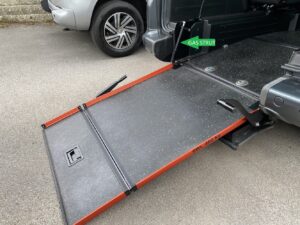
These are generally one of the easier ramp systems to repair if the ramp becomes heavy.
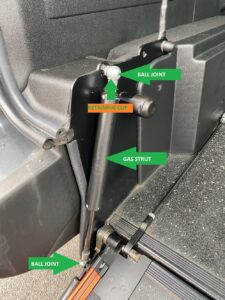
The fault is usually the larger of the two gas struts fitted to the ramp, located on the left-hand side.
There are two gas struts, but it is the larger one that normally needs replacing.
To remove it, the retaining clips at the top and bottom ball joints need to be released. The ramp must be properly supported and secured before attempting to remove the strut.
Once the retaining clips have been removed, the gas strut can be carefully released from its ball joints. When fitting the replacement, the removal process is simply reversed.
Replacement gas struts can be ordered through the Allied Vehicles Parts Department on 0800 587 9622. Check the correct part for your particular conversion before ordering.
How to Fix a Heavy Ramp on an Allied Vehicles Peugeot Partner Tepee Horizon WAV (2014–2016)
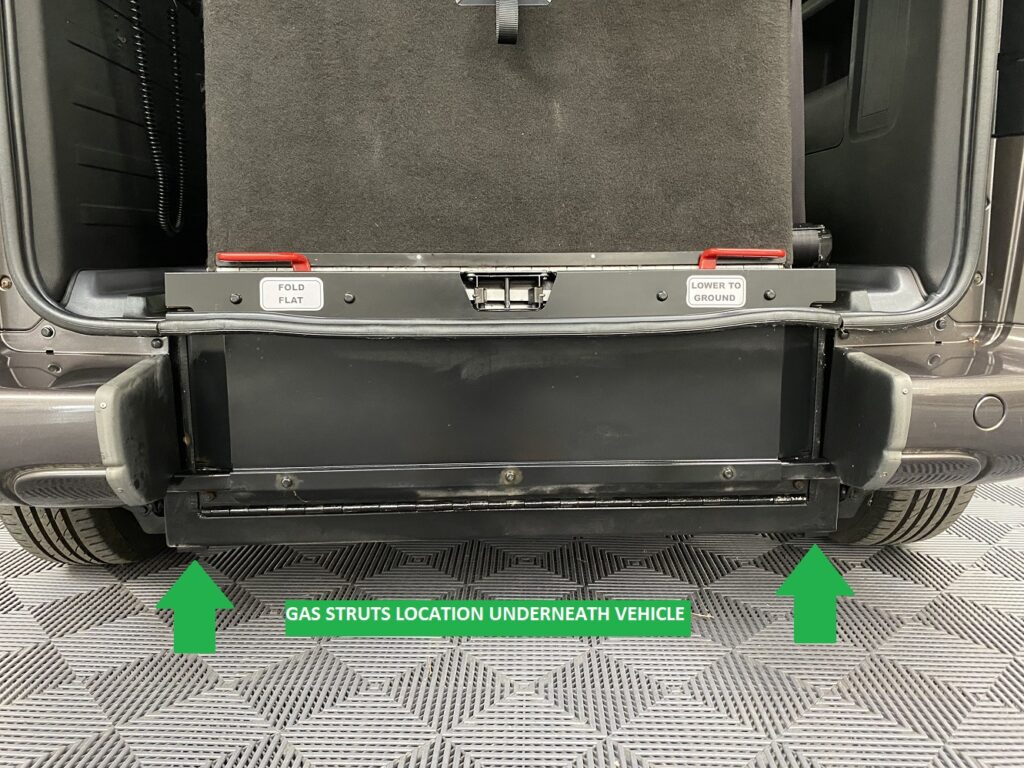
The earlier version of the Peugeot Partner Tepee Horizon uses a different arrangement.
These ramps have two gas struts fitted underneath the vehicle, one on either side of the ramp. Like the later model, failed gas struts are a common reason for the ramp becoming heavy.
From experience, I would always recommend replacing both struts together rather than just one. This helps ensure that the ramp has the assistance it needs on both sides.
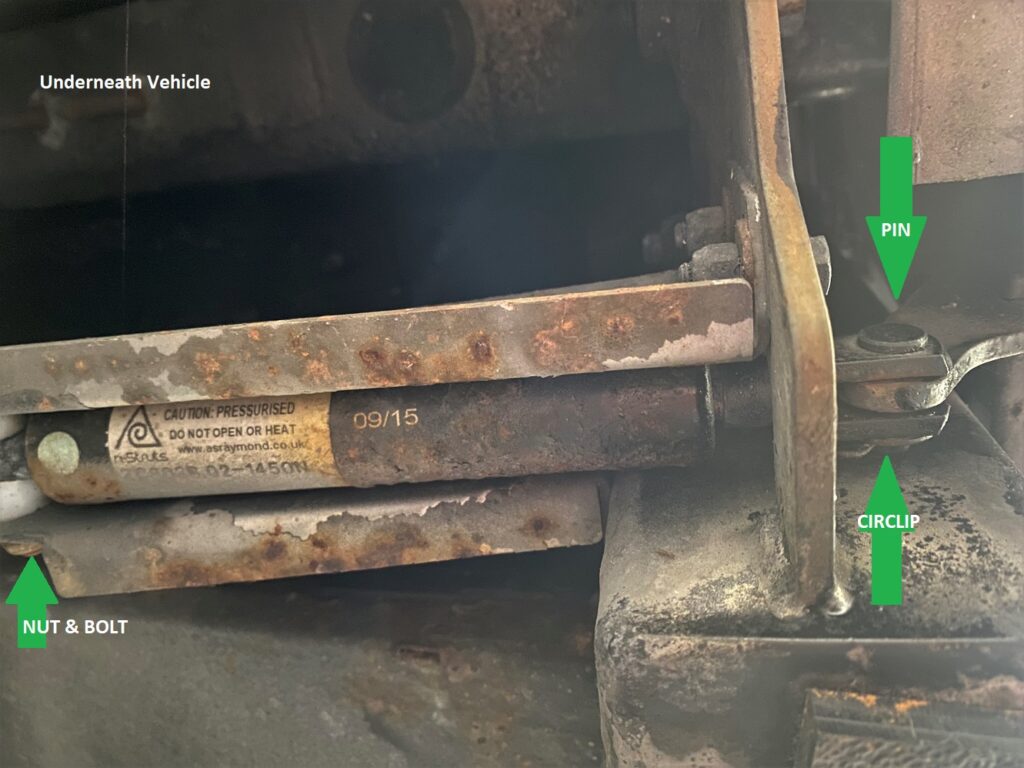
Each gas strut has two mounting points. At one end, there is a metal pin secured with a split pin. At the other end, it is secured with a nut and bolt, which I believe is 13mm.
The pins can sometimes become seized and may need careful attention to remove them. Access to the fixings underneath the vehicle can also be awkward, so suitable vehicle lifting equipment can make the job easier.
Replacement gas struts are available through the Allied Vehicles Parts Department on 0800 587 9622.
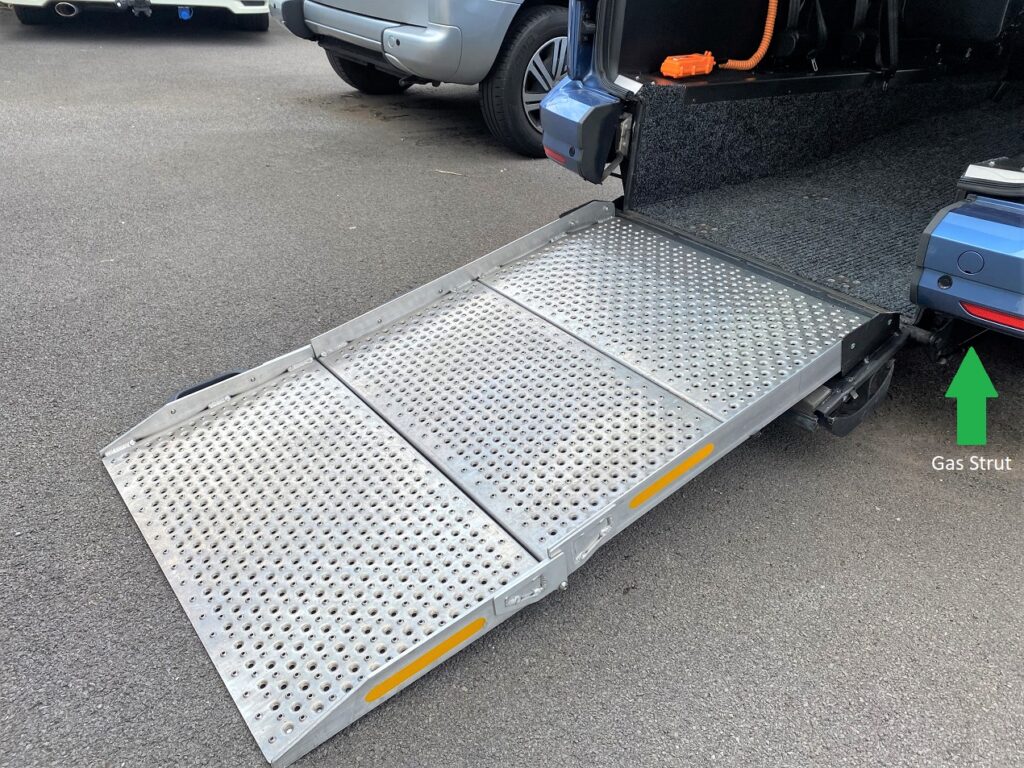
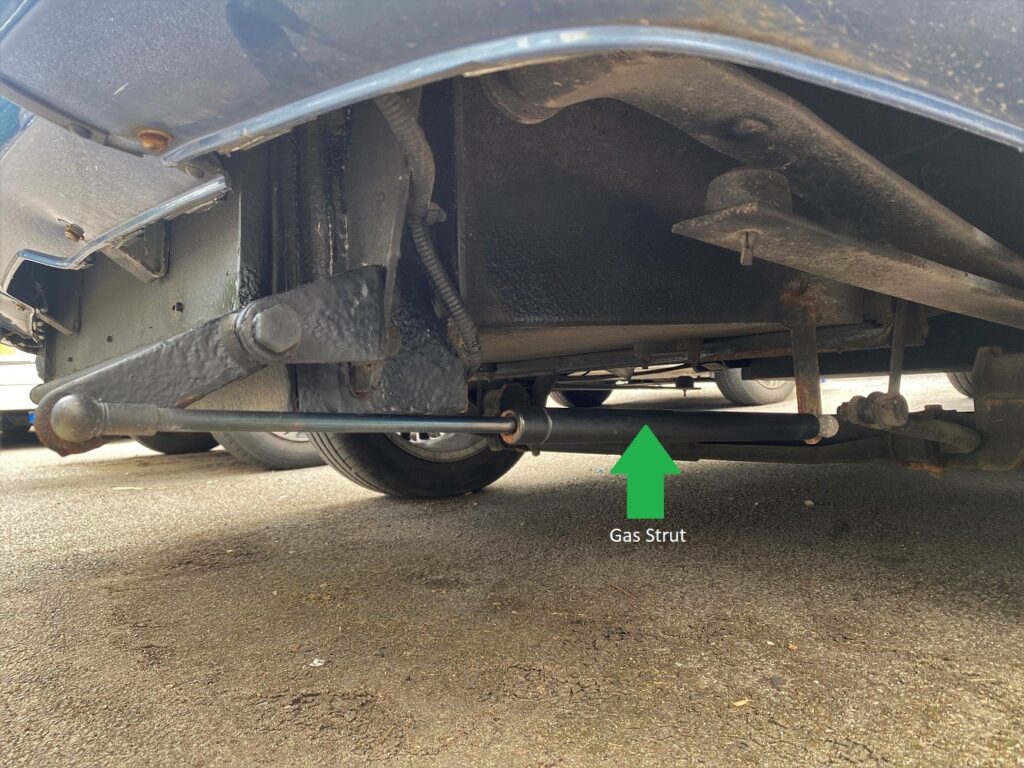
How to Fix a Heavy Ramp on an Automotive Group Citroën Berlingo WAV (2015–2022)
The Automotive Group Citroën Berlingo conversion uses a long, single gas strut fitted underneath the vehicle.
One of the most common faults we have encountered is a ball joint mounting shearing off where the gas strut attaches to either the vehicle or the ramp.
When this happens, the gas strut may hang down and no longer provide any assistance.
I have also seen vehicles where the gas strut has been completely removed as a temporary solution after one of its mounting points has failed and the strut has started rubbing on the ground.
If you have an Automotive Group converted Citroën Berlingo and find that the ramp is unusually heavy, it is worth checking whether the gas strut is still attached.
In my experience, the mounting failure can be caused by the gas strut beginning to seize, placing additional strain on the ball joints. For this reason, I would recommend replacing the gas strut and both ball joints together.
Fortunately, the replacement gas strut is supplied with new ball joints.
The struts can be ordered through the Automotive Group Parts Department. The replacement procedure has two main fixings, one at either end of the strut, although access underneath the vehicle needs to be considered.


How to Fix a Heavy Ramp on an Automotive Group VW Caddy Maxi WAV (2015–2022)
The Automotive Group VW Caddy Maxi uses essentially the same ramp arrangement as the Citroën Berlingo described above, although the ramp may be a few centimetres narrower.
Because the ramp system is manufactured by the same company, we generally see the same faults.
The gas strut may have failed and stopped providing assistance, or one of the ball-joint mountings may have sheared off, leaving the strut no longer attached to the vehicle or ramp.
A replacement gas strut can be ordered through the Automotive Group Parts Department.
How to Fix a Heavy Ramp on a Gowrings Mobility Fiat Doblo WAV
The Gowrings Mobility converted Fiat Doblo also uses gas struts to assist with raising and lowering the rear ramp.
These vehicles have two gas struts, one on either side of the ramp. As with the other conversions, the struts can fail over time, leaving the ramp much heavier to operate.
On one vehicle we repaired, the mounting point for the gas strut had also sheared off.
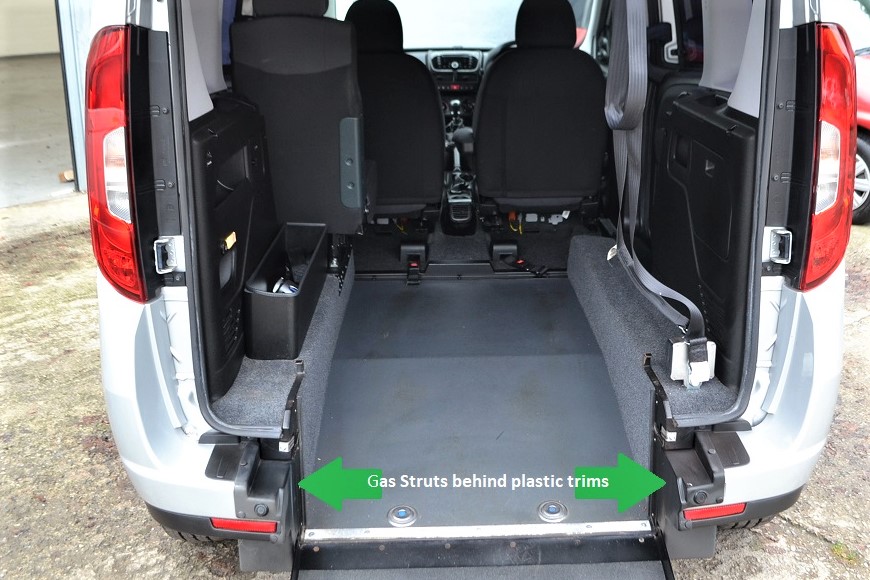
To access the gas struts, the moulded plastic bumper end caps fitted to either side of the ramp need to be removed.
Replacement gas struts can be ordered through the Gowrings Mobility Parts Department on 0345 608 8020.
It has been some time since I last ordered these parts, but if my memory serves me correctly, the gas struts have since been upgraded to include thicker ball-joint mountings.
Because of the upgraded fittings, the refitting process is a little more involved and may require the mounting holes in the ramp and vehicle to be enlarged to accommodate the replacement parts. This should be checked against the correct fitting instructions before any modification is carried out.
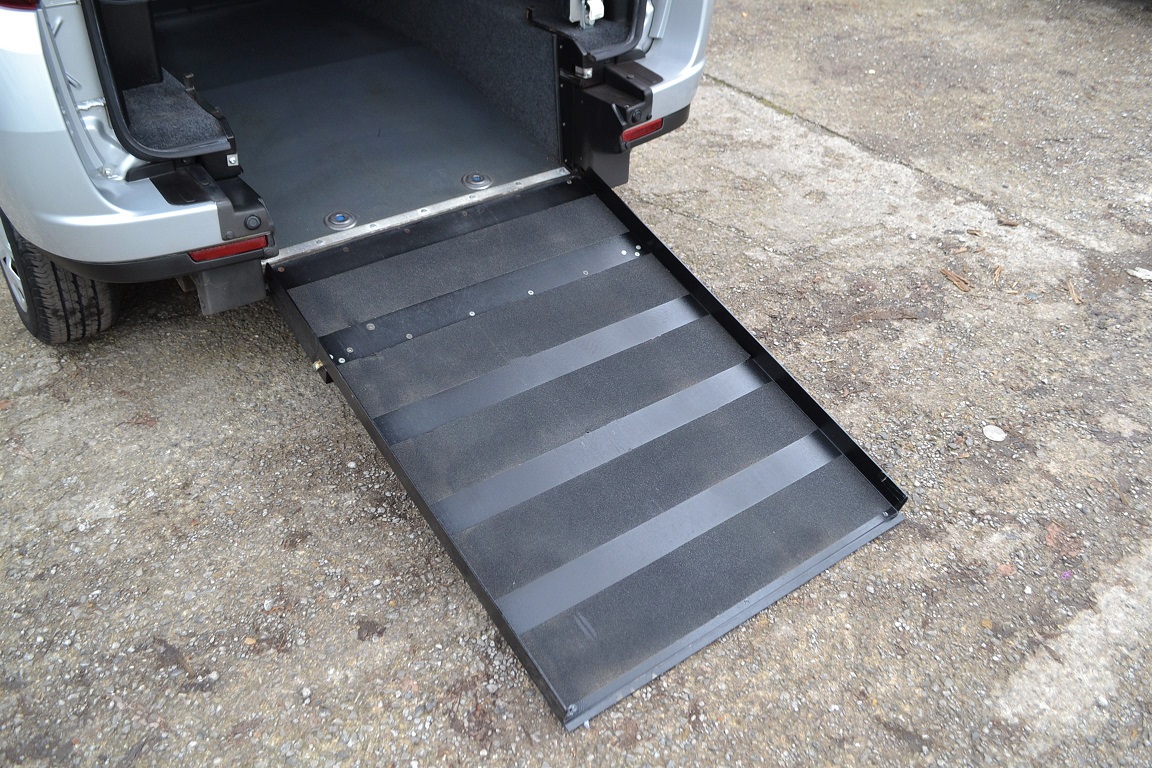
Unfortunately, I don’t have detailed photographs showing the gas struts on this particular conversion. The photographs included are from a Fiat Doblo I previously had in stock.
What If Your WAV Ramp Is Still Heavy After Replacing the Gas Struts?
The gas struts and their mounting points are common causes of heavy ramps on the conversions covered in this article. However, they are not necessarily the only possible causes.
If the ramp is still difficult to operate after the struts have been replaced, it is worth having the hinges, pivots and other moving parts inspected.
It is also important to make sure the replacement struts are the correct specification for the particular vehicle and conversion. A strut that looks similar is not necessarily the correct replacement.
Final Thoughts
A wheelchair accessible vehicle ramp should be reasonably easy to raise and lower when its assistance system is working correctly.
If your ramp has gradually become heavier, a failed gas strut or damaged mounting point may be the cause. The examples in this article are based on faults we have encountered on the different WAV conversions over the years.
I hope this guide has helped explain some of the common problems that can affect wheelchair accessible vehicle ramps and provided a useful starting point when identifying a possible fault.
Please remember that the information above relates to specific conversions and is intended as general guidance. Always use the correct replacement parts and seek professional assistance if you are unsure about carrying out a repair.
Looking to Replace Your Wheelchair Accessible Vehicle?
If you are considering changing your current wheelchair accessible vehicle, Michael Harraway Cars offers a range of quality used WAVs at our showroom in St Georges, Weston-super-Mare.
We have specialised in wheelchair accessible vehicles for many years and can help you find a vehicle that suits your wheelchair, mobility needs and budget.
You can view our current stock and find out more about Michael Harraway Cars on our website: